
Few watches occupy the same cultural and collector-driven pedestal as the Rolex Cosmograph Daytona 126502. For decades, the stainless steel Daytona has been defined by a strict aesthetic code—contrasting sub-dials, restrained colorways, and incremental evolution rather than disruption.
In 2026, that changes.
The Daytona Rolesium 126502 introduces a combination that feels both radical and deeply rooted in Rolex’s heritage: a full white grand feu enamel dial, a vintage-inspired ceramic bezel, and—perhaps most intriguingly—a steel-and-platinum construction paired with an exhibition caseback. It’s a watch that challenges long-standing norms while carefully preserving the DNA that made the Daytona legendary.
But does it succeed as a modern collector’s piece—or is it a departure too far?
Brand & Historical Context
Since its debut in 1963, the Rolex Cosmograph Daytona has evolved into one of the most recognizable chronographs in horology. Originally designed for professional racing drivers, the Daytona’s tachymeter scale and robust chronograph movement were built for timing speed with precision.
Over time, however, the Daytona transcended its tool-watch origins. It became a cultural icon—helped in no small part by associations with figures like Paul Newman—and a cornerstone of the modern luxury sports watch market.
Historically, steel Daytonas adhered to a rigid dial formula: either black with contrasting light sub-dials or white with darker counters. Deviations were rare, and full monochrome executions were virtually nonexistent in standard production.
The 126502 breaks that pattern decisively.
Case Design & Wearability
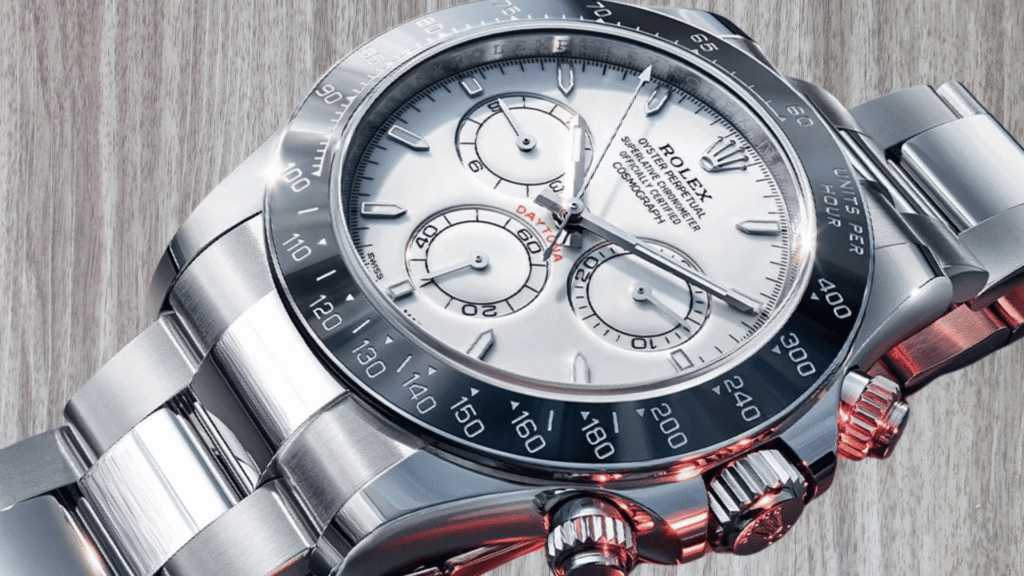
At its core, the Rolesium 126502 retains the updated Daytona architecture introduced in 2023. The 40mm Oyster case—crafted primarily from Oystersteel—strikes a near-perfect balance between sportiness and elegance.
With a thickness of just 11.9mm, the watch wears slimmer than many modern chronographs, slipping comfortably under a cuff while maintaining a solid wrist presence. The refined case proportions, slightly broader lugs, and improved symmetry contribute to a more contemporary silhouette without sacrificing recognizability.
Where things get interesting is in the material composition.
“Rolesium,” a term historically associated with steel and platinum combinations in Rolex’s catalog, is applied here in a novel way. The bezel is framed by platinum, while the caseback itself is rendered in platinum and fitted with a sapphire crystal—an unusual move for a predominantly steel Daytona.
This exhibition caseback is more than a visual novelty; it represents a philosophical shift for Rolex, a brand long known for keeping its movements hidden.
Water resistance remains at 100 meters, with screw-down pushers and the Triplock crown ensuring robustness in everyday use.
Dial Details & Finishing
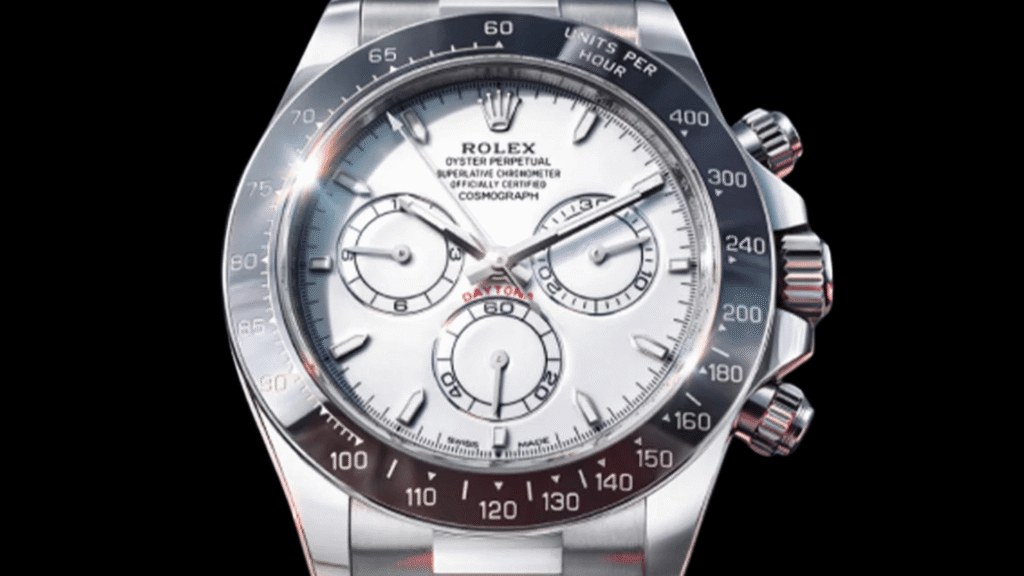
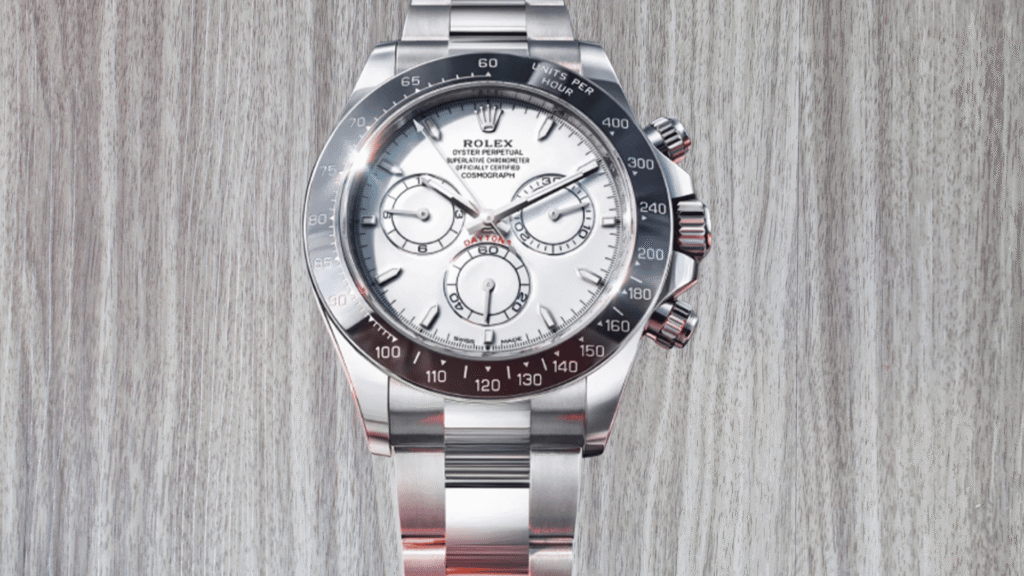
The dial is, without question, the defining feature of this reference.
Executed in grand feu enamel, the stark white surface offers a depth and permanence that lacquer simply cannot replicate. The enamel is applied to ceramic discs—one for the main dial and three for the sub-dials—before being mounted onto a brass base. The result is a flawless, glossy finish with remarkable resistance to aging.
What makes this dial particularly compelling is its lack of contrast.
Gone are the traditional black rings or contrasting sub-dials. Instead, the watch presents a monochromatic, almost architectural aesthetic. The sub-dials subtly emerge from the surface rather than demanding attention, creating a cleaner and more refined visual experience.
Applied hour markers in 18k white gold, filled with Chromalight, provide legibility without disrupting the dial’s purity. The red “Daytona” script above the 6 o’clock counter offers just enough color to anchor the design.
This is not a loud dial. It’s a confident one.
Movement & Technical Analysis
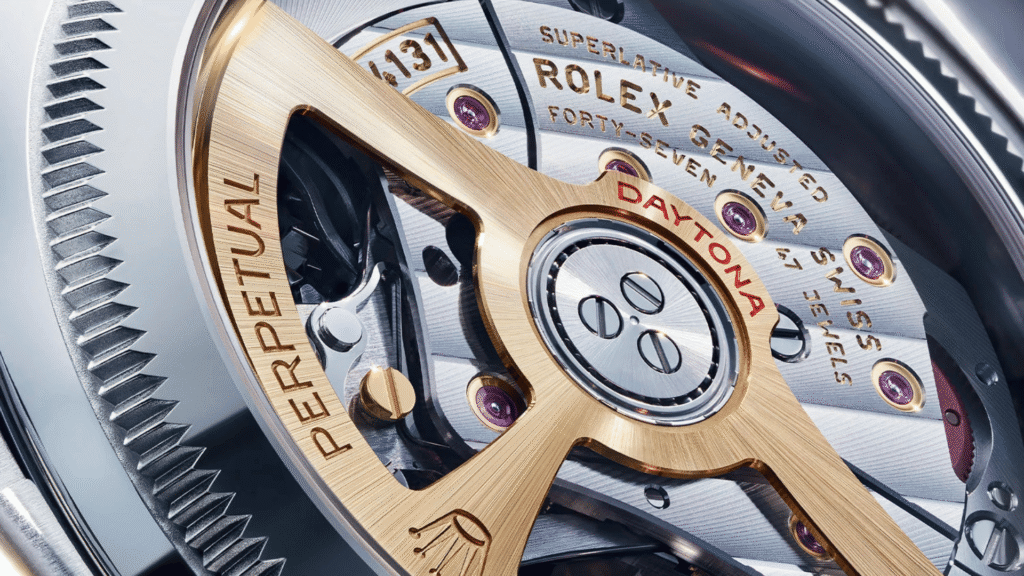
Powering the 126502 is the Rolex Calibre 4131, the latest evolution of Rolex’s in-house chronograph architecture.
Visible through the sapphire caseback, the 4131 represents a significant refinement over the long-serving 4130. While maintaining the same integrated chronograph layout with a column wheel and vertical clutch, it introduces several key enhancements:
- Chronergy escapement for improved efficiency and magnetic resistance
- Blue Parachrom hairspring with superior stability under temperature variations
- 72-hour power reserve, ideal for weekend rotation
- Rolex Geneva stripes, adding a level of finishing rarely emphasized by the brand
The movement operates at 28,800 vibrations per hour (4Hz), ensuring smooth chronograph operation and precise timekeeping. As expected, it carries the Superlative Chronometer certification, guaranteeing accuracy within -2/+2 seconds per day after casing.
Technically, the vertical clutch ensures the chronograph seconds hand starts without stutter, while the column wheel provides a crisp, tactile pusher feel—hallmarks of a high-end chronograph.
While Rolex movements are often criticized for their conservative finishing, the visible 4131 bridges the gap between engineering excellence and aesthetic appeal.
Bracelet & Comfort
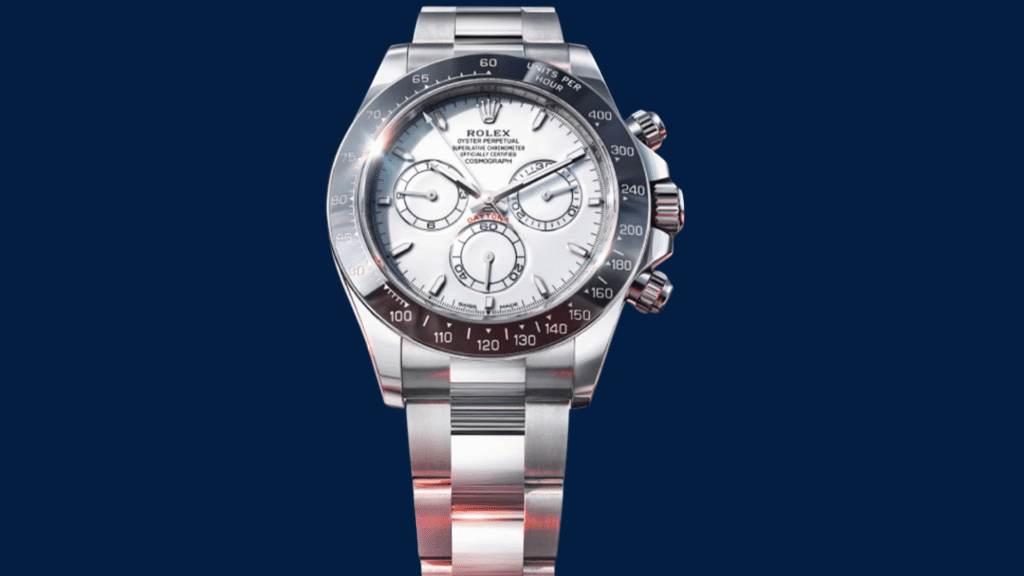
The Rolesium Daytona is fitted with the classic Oyster bracelet in Oystersteel, featuring a three-link construction with polished center links and satin-brushed outer links.
On the wrist, the bracelet delivers the familiar Rolex blend of durability and comfort. The Oysterlock clasp provides security, while the Easylink extension system allows for quick micro-adjustments of approximately 5mm—particularly useful in warmer climates.
The bracelet’s 20mm lug width ensures balanced proportions, complementing the case without overpowering it.
Pricing & Availability
The Rolex Daytona Rolesium 126502 is positioned as an off-catalogue release, adding an element of exclusivity to an already highly sought-after model.
With an approximate price of €55,000, it sits well above standard steel Daytonas, reflecting both its material complexity and limited availability.
As with most modern Rolex sports watches, actual market availability will likely be constrained, with secondary market prices expected to exceed retail significantly.
Final Verdict
The Rolex Daytona Rolesium 126502 is not merely a new reference—it’s a statement.
It challenges long-standing conventions by introducing a full enamel dial, reinterpreting vintage design cues through modern materials, and embracing transparency with its exhibition caseback. Yet, it does so without compromising the core principles that define the Daytona: precision, durability, and timeless design.
From a collector’s perspective, this is a fascinating piece. It offers something genuinely different within a historically conservative lineup, while still retaining the intrinsic value and recognition of the Daytona name.
However, it won’t be for everyone.
Traditionalists may find the monochromatic dial too subtle, and purists might question the departure from closed casebacks. But for those who appreciate nuance, craftsmanship, and evolution within constraint, the 126502 represents one of the most compelling Daytona releases in recent years. For more details, please visit rolex.com.
Technical Specifications
| Feature | Details |
|---|---|
| Model | Rolex Cosmograph Daytona Rolesium 126502 |
| Case Diameter | 40mm |
| Thickness | 11.9mm |
| Case Material | Oystersteel with platinum elements (Rolesium) |
| Bezel | Anthracite Cerachrom ceramic with platinum-filled tachymeter |
| Caseback | Platinum with sapphire exhibition window |
| Water Resistance | 100 meters |
| Dial | White grand feu enamel with matching sub-dials |
| Markers | 18k white gold with Chromalight |
| Movement | Calibre 4131 (automatic, in-house) |
| Frequency | 28,800 vph (4Hz) |
| Power Reserve | 72 hours |
| Chronograph | Column wheel, vertical clutch |
| Bracelet | Oystersteel Oyster bracelet |
| Clasp | Oysterlock with Easylink extension |
| Lug Width | 20mm |
| Price | Approx. €55,000 |
| Availability | Off-catalogue |