
Few names in modern dive watchmaking carry the same weight as Seiko’s Marinemaster. Within the broader Prospex universe, this designation has consistently marked the brand’s most purpose-built, no-compromise professional instruments. With the introduction of the Seiko Prospex Marinemaster 1968 Heritage Diver HBF001 and the JAMSTEC Limited Edition HBF002, Seiko isn’t merely revisiting a classic—it’s refining a lineage that has quietly become one of the most credible alternatives to Swiss luxury divers.
This latest generation signals something important: Seiko is closing the gap between tool watch ruggedness and luxury-level refinement, without abandoning its utilitarian DNA. The result is a pair of dive watches that feel less like iterations—and more like maturation.
Brand & Historical Context
Seiko’s dive watch story begins in 1965, but it was the 1968 Hi-Beat 300m diver that truly established the blueprint for the brand’s high-performance underwater instruments. That reference introduced a design language and technical philosophy that still resonates today—angular, functional, and engineered for serious depth.
The Marinemaster name itself, first seen in 2000, became shorthand for Seiko’s top-tier mechanical divers. Unlike the more accessible Prospex offerings, Marinemaster models have traditionally leaned toward professional-grade specifications, often incorporating movements and construction techniques derived from Grand Seiko-level engineering.
The HBF001 and HBF002 sit squarely within this lineage. They draw heavily from the 1968 aesthetic while incorporating modern materials, updated ergonomics, and a movement architecture that signals Seiko’s continued vertical integration ambitions.
Case Design & Wearability
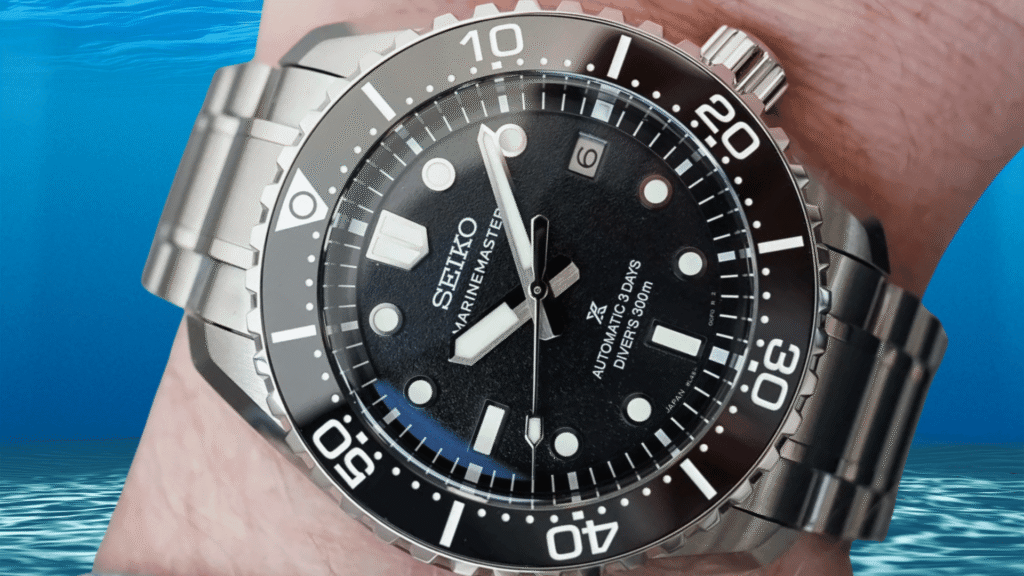
At first glance, the case architecture feels familiar—but closer inspection reveals thoughtful refinement.
The stainless steel case measures 42.6mm in diameter, with a lug-to-lug span of 49.3mm. Thickness has increased slightly to 14.1mm, largely due to the upgraded movement. While that might raise concerns on paper, in practice the proportions remain well-balanced for a professional diver.
The finishing is where Seiko quietly excels. Broad brushed surfaces dominate, contrasted by sharply defined polished bevels along the case flanks. This interplay of textures gives the watch a level of visual sophistication that goes beyond typical tool watches in this segment.
Functionality remains paramount. The screw-down crown at 4 o’clock is deeply recessed and well-protected, maintaining Seiko’s ergonomic advantage. The unidirectional bezel features pronounced notches for grip—an essential detail for gloved operation.
A notable upgrade is the introduction of a ceramic bezel insert. This not only enhances scratch resistance but elevates the tactile and visual experience, aligning the Marinemaster more closely with luxury diver expectations.
Dial Details & Finishing
This is where the two references diverge most dramatically.
HBF001 – The Purist’s Choice
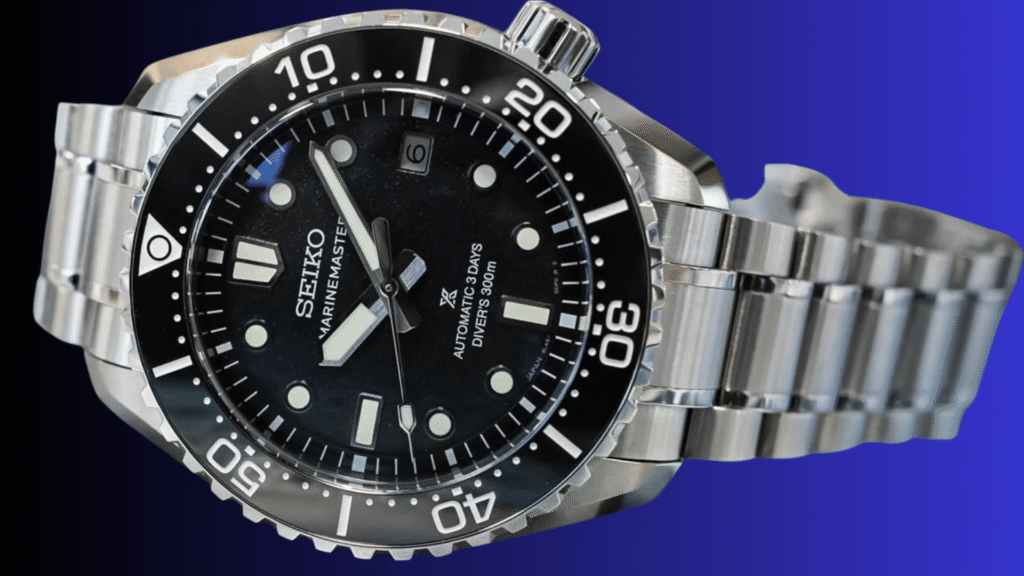
The black dial variant embraces restraint. Its finely grained surface reduces glare, reinforcing legibility under harsh lighting conditions. Applied markers are bold and generously filled with LumiBrite, delivering the kind of low-light performance Seiko is known for.
The repositioned date at 3 o’clock improves symmetry, while the addition of a small luminous marker beside it ensures functionality isn’t compromised.
HBF002 – Experimental and Expressive
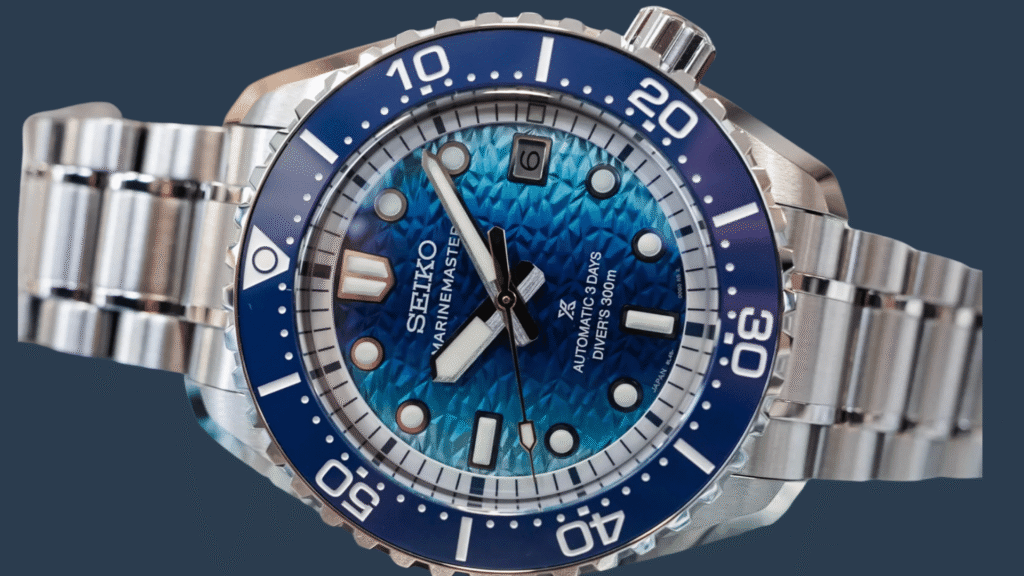
The JAMSTEC Limited Edition is far more ambitious.
Its dial texture is inspired by ice-breaking vessels carving through frozen seas—a concept that translates into a deeply stamped surface with a vertical gradient transitioning from white to deep blue. The execution is striking, particularly under changing light conditions where the glossy coating amplifies depth and contrast.
Gold accents on the seconds hand add a subtle warmth, while the white minute flange enhances readability against the textured background. This is not a conservative design—and that’s precisely its appeal.
Movement & Technical Analysis
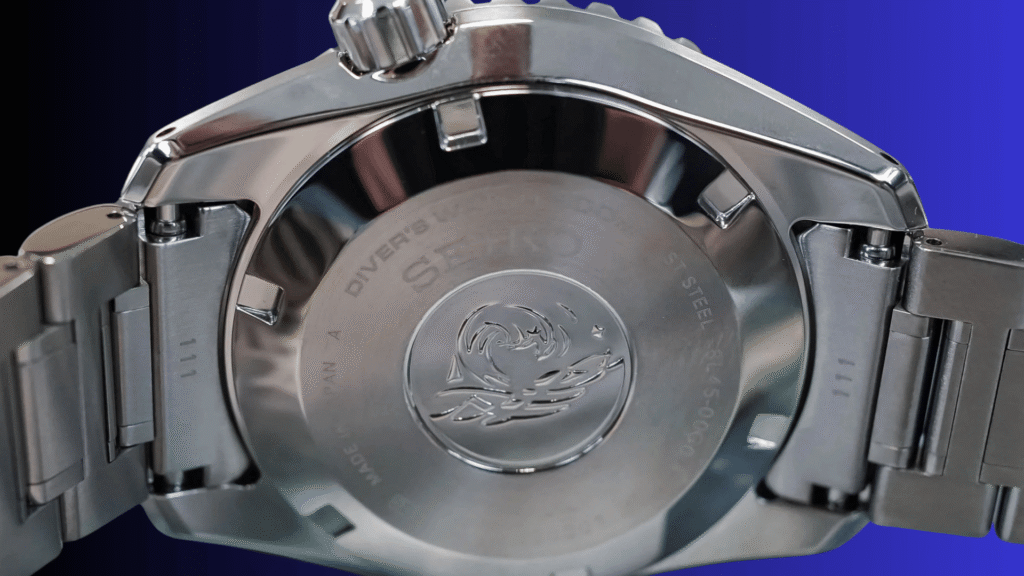
The introduction of the Calibre 8L45 marks a significant upgrade.
Derived from the architecture of Grand Seiko’s 9S65, this in-house automatic movement brings tangible improvements over its predecessor. Power reserve is now extended to 72 hours, placing it comfortably within modern expectations for a high-end diver.
Accuracy is rated at +10 to -5 seconds per day—respectable, though still slightly behind COSC-certified Swiss competitors on paper. However, Seiko’s real-world performance often exceeds these conservative figures.
The movement operates at 28,800 vibrations per hour and incorporates Spron alloys for the mainspring and hairspring, enhancing durability and resistance to environmental stress.
While not designed for display casebacks, the finishing is noteworthy for this category, featuring clean striping across bridges and rotor. It’s functional, but far from crude.
Bracelet & Comfort
Seiko has made meaningful progress here.
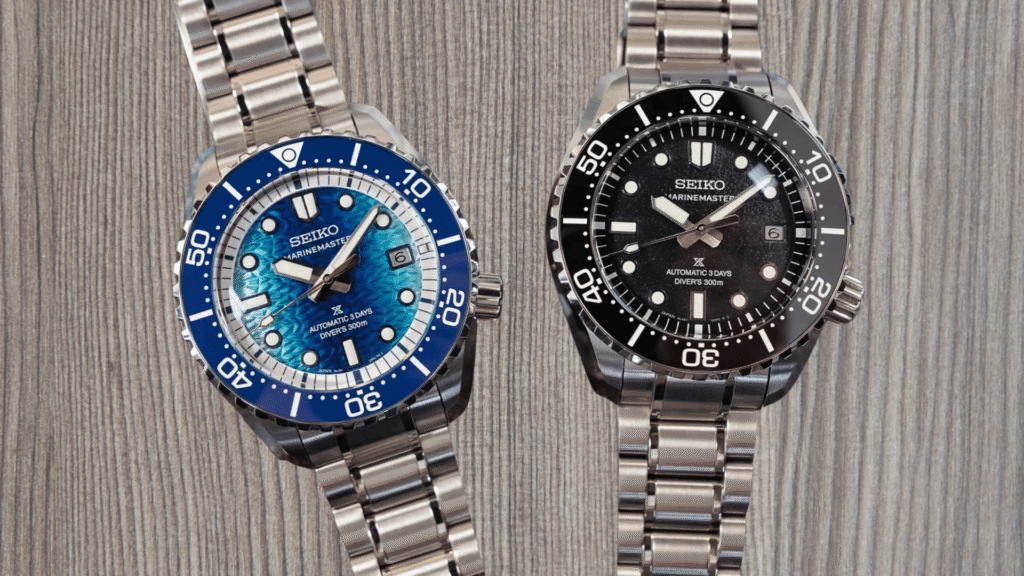
The three-link stainless steel bracelet retains a familiar aesthetic but is now paired with a redesigned clasp featuring a micro-adjustment system. This allows for up to 16mm of incremental adjustment without tools—a significant advantage for divers who need to accommodate wetsuits or temperature-related wrist expansion.
The bracelet benefits from the same hard coating as the case, improving long-term resistance to scratches. Combined with solid end links and a secure clasp mechanism, it delivers a reassuring sense of durability.
Real-World Wrist Presence
Despite its professional specifications, the Marinemaster wears surprisingly well.
The case geometry and downward-curving lugs help distribute weight evenly, while the crown position prevents wrist bite. The added thickness is noticeable but not prohibitive—especially for those accustomed to serious dive watches.
On the wrist, the HBF001 feels understated and purposeful. The HBF002, by contrast, commands attention. It’s a conversation piece, but one that remains grounded in functional design.
Pricing & Availability
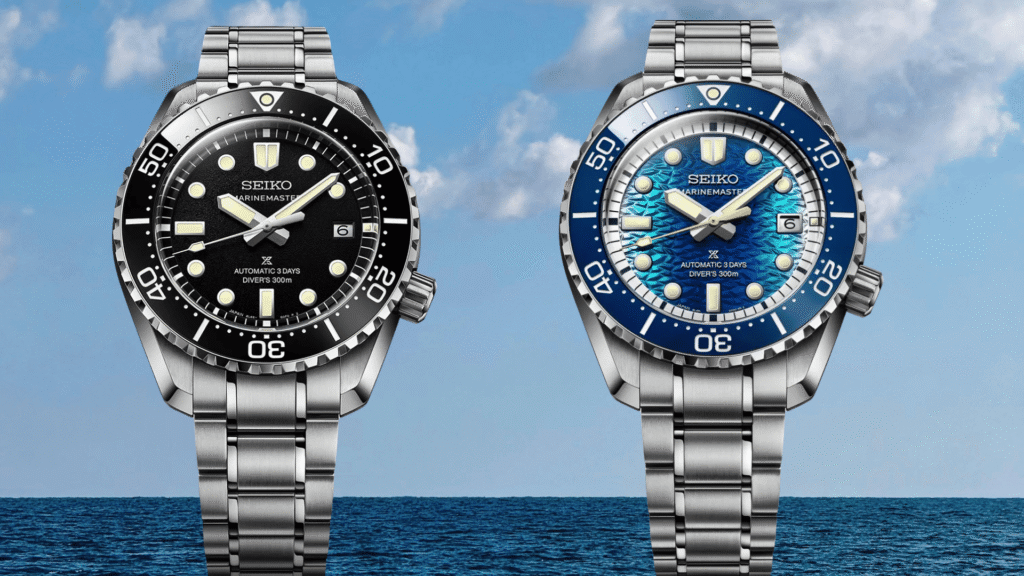
The HBF001 enters the permanent collection, while the HBF002 is limited to 1,000 pieces.
- HBF001: €3,800
- HBF002 (Limited Edition): €4,100
Positioned at the upper end of Seiko’s Prospex range, these models sit just below the brand’s flagship professional divers. Pricing reflects both the upgraded movement and the improved materials, placing them in direct competition with entry-level Swiss luxury divers.
Collector Perspective
From a collector’s standpoint, this release is particularly compelling.
The Marinemaster line has always occupied a niche—respected, but somewhat overshadowed by Swiss competitors. With this generation, Seiko strengthens its position by addressing long-standing critiques: movement performance, bezel materials, and bracelet adjustability.
The HBF001 offers long-term versatility. It’s the kind of watch that can anchor a collection, balancing tool-watch credibility with everyday wearability.
The HBF002, on the other hand, has clear collectible appeal. Limited production, a distinctive dial, and its association with marine research all contribute to its desirability. While it may not achieve immediate secondary market premiums, its uniqueness gives it strong long-term potential.
More broadly, these models signal Seiko’s intent to push further into the premium segment—a move that could reshape perceptions of the brand among seasoned collectors.
Final Verdict
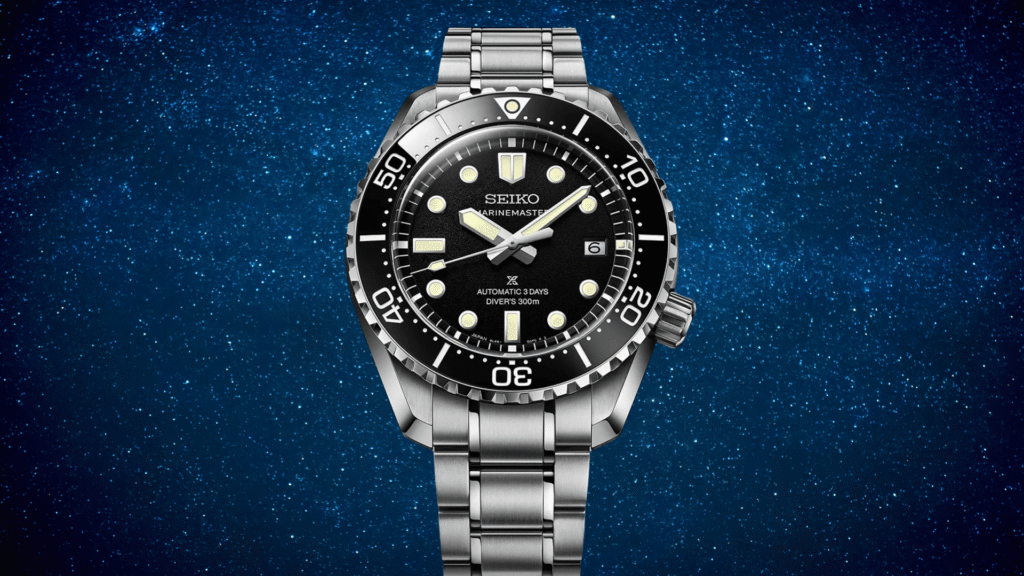
The Seiko Prospex Marinemaster 1968 Heritage Diver HBF001 and HBF002 represent a confident evolution rather than a radical reinvention.
Seiko has refined what matters: durability, legibility, movement performance, and user-focused functionality. At the same time, it has elevated the overall experience through better materials and more considered design.
These are not entry-level divers, nor are they meant to be. They are serious instruments for enthusiasts who appreciate engineering depth and historical continuity.
If you’re looking for a dive watch that bridges the gap between professional utility and understated luxury—without defaulting to the usual Swiss suspects—the new Marinemaster deserves serious consideration.
Technical Specifications
| Feature | Specification |
|---|---|
| Model | Seiko Prospex Marinemaster 1968 Heritage Diver |
| References | HBF001 (Black), HBF002 (JAMSTEC Limited Edition) |
| Case Diameter | 42.6mm |
| Thickness | 14.1mm |
| Lug-to-Lug | 49.3mm |
| Case Material | Stainless steel with super-hard coating |
| Crystal | Dual-curved sapphire with anti-reflective coating |
| Bezel | Unidirectional, ceramic insert |
| Water Resistance | 300 meters |
| Movement | Calibre 8L45 (Grand Seiko 9S65 base) |
| Power Reserve | 72 hours |
| Frequency | 28,800 vph |
| Accuracy | +10 / -5 seconds per day |
| Jewels | 35 |
| Functions | Hours, minutes, seconds, date |
| Bracelet | Stainless steel, 3-link with hard coating |
| Clasp | Folding clasp with 16mm micro-adjustment |
| Production | HBF001: Regular production / HBF002: Limited to 1,000 pieces |
| Price | €3,800 (HBF001), €4,100 (HBF002) |